Discover what makes a handmade marble sink unique, from natural stone selection and craftsmanship to custom design, durability, care and timeless beauty.
Why Choose a Marble Sink? The Importance of Craftsmanship in Natural Stone
A remarkable bathroom is defined by more than furniture, fixtures and color.
Its character often comes from the materials that occupy the space and the way those materials have been shaped.
This is what makes a marble sink fundamentally different from an ordinary bathroom fixture.
Natural marble carries veining, mineral movement and tonal variation formed over millions of years. When that material is transformed through thoughtful design and skilled craftsmanship, the result is not simply a sink.
It becomes a unique architectural element.
Mass-produced materials can create thousands of nearly identical pieces. Natural marble cannot.
Every block is different.
And that individuality is at the heart of what makes a handmade marble sink special.
What Is a Marble Sink?
A marble sink is a bathroom basin produced from natural marble and shaped into a functional sink form.
It can take many forms, including countertop basins, wall-mounted sinks, double vanities, integrated backsplashes and sculptural custom pieces.
Unlike a surface that merely imitates stone, genuine marble brings the actual texture, depth and geological character of natural stone into the interior.
Different stones can also transform the personality of exactly the same design.
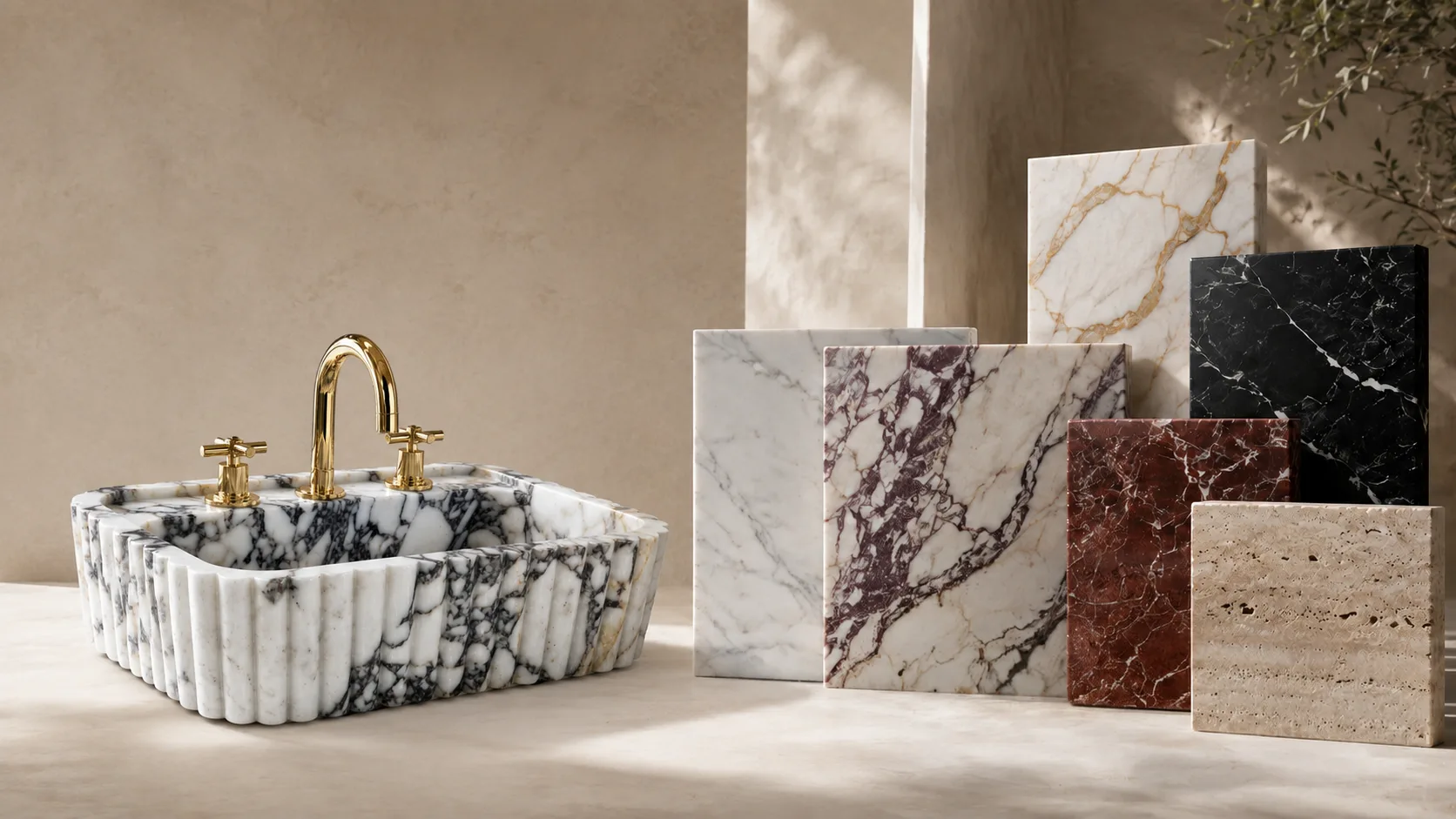
The quiet gray movement of Carrara White creates an entirely different atmosphere from dramatic Calacatta veining. Nero Marquina offers depth and contrast, while Rosso Levanto introduces expressive color. Travertine can create a softer, warmer and more organic feeling.
Choosing a marble sink therefore involves more than choosing a shape.
You are also choosing the character of the stone itself.
Why Does Craftsmanship Matter?
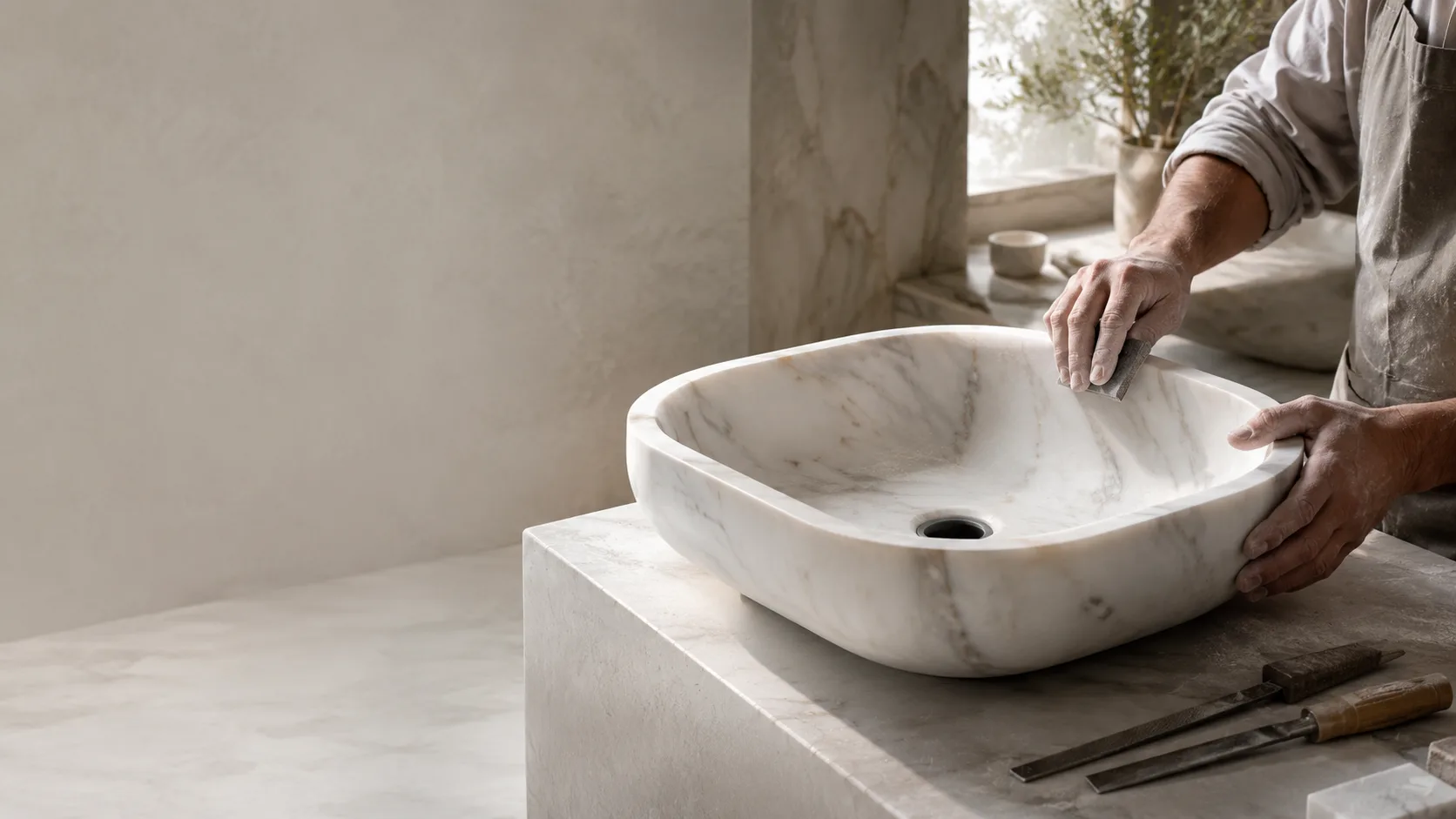
The quality of a marble sink depends not only on the marble selected but also on how that marble is interpreted and shaped.
Natural stone is durable, but working with it requires knowledge and precision.
The direction of the veining, structural characteristics of the slab or block, wall thickness, basin depth, drainage geometry, edge profiles and surface finish all need to work together.
A skilled craftsperson does more than remove material.
They understand the stone.
They consider how the veins should move across the finished piece, which areas should become visual focal points and how the natural character of the marble can remain visible within the final design.
Excellent craftsmanship does not fight the stone.
It works with it.
No Two Pieces of Natural Marble Are Identical
One of the most important differences between natural stone and mass-produced materials is variation.
Every marble block contains its own combination of veins, tones, mineral traces and movement.
As a result, even two sinks made in the same design and from the same type of marble will never be completely identical.
The difference becomes especially striking in expressive materials such as Calacatta Viola, Rosso Levanto and Nero Marquina.
For homeowners, interior designers and architects, this natural variation offers something that standardized materials cannot provide:
individuality.
A beautifully selected marble sink can become a focal point that gives an otherwise minimal bathroom its identity.
Stone Selection Is the Beginning of the Design
The production of a high-quality marble basin begins long before the stone is shaped.
It begins with selection.
Color matters, but color alone is not enough.
Vein direction, overall movement, structural characteristics, project dimensions and the desired architectural style should all influence the decision.
Carrara White may work beautifully in a restrained, minimalist bathroom.
A highly expressive Calacatta Viola or Rosso Levanto can become a statement piece in an interior that calls for stronger visual movement.
Darker natural stones can create a sophisticated, architectural atmosphere.
There is no single stone that is correct for every project.
The right stone is the one whose natural character supports the design.
Handmade vs. Mass-Produced Marble Sinks
Mass production prioritizes repeatability.
Craftsmanship prioritizes detail.
Modern technology can play an important role in natural stone fabrication, and craftsmanship does not require rejecting precision tools or contemporary production methods.
In fact, some of the best results come from combining technical accuracy with human judgment.
Machines can help achieve precise dimensions.
Craftsmanship determines how the finished object feels.
The relationship between the basin and its edges, the transitions between surfaces, the treatment of visible veining and the final finishing process all contribute to the overall quality of the piece.
A handmade marble sink is therefore not valuable simply because human hands were involved.
Its value comes from the decisions made throughout the process.
What Should You Look for in a Quality Marble Sink?
It is easy to focus entirely on the color of the stone when first looking at a marble basin.
True quality becomes clearer when you examine the details.
The basin should feel visually balanced. Drainage should be considered as part of the geometry. Edges and transitions should be clean, and the area surrounding the drain should be carefully finished.
Surface treatment is equally important.
Polished marble creates a different effect from honed or more naturally textured stone. The right finish depends on both the marble selected and the design of the space.
Good craftsmanship should look convincing from a distance and remain impressive when viewed up close.
How Can a Marble Sink Transform a Bathroom?
Bathrooms often contain large areas of relatively quiet materials.
Floors, wall finishes and cabinetry create the architectural background.
The sink naturally becomes one of the most frequently viewed and used elements in the room.
This gives a marble basin the opportunity to define the entire space.
In a minimalist bathroom, a sculptural marble sink can become the primary statement without additional decoration.
Traditional environments may benefit from carved details and expressive stone.
Contemporary projects can explore geometric forms, fluted surfaces, integrated backsplashes and wall-mounted designs.
The ability of marble to work across such different styles is one reason natural stone remains timeless.
Wall-Mounted or Countertop Marble Sink?
The best configuration depends on the architecture and the way the bathroom will be used.
A countertop marble basin can integrate naturally with existing furniture and vanity systems.
A wall-mounted marble sink can create a more architectural appearance, particularly when the basin, front surface and backsplash are visually connected through the same stone.
Larger spaces can also accommodate double marble sinks, creating both functional capacity and a stronger sense of symmetry.
Rather than choosing a sink independently, the dimensions of the room, plumbing requirements, user habits and interior concept should be considered together.
The Advantage of a Custom Marble Sink
Not every interior follows standard dimensions.
Private residences, villas, boutique hotels, hospitality projects and architect-designed bathrooms often require solutions that cannot be achieved with an off-the-shelf product.
Natural stone provides significant freedom in this respect.
Width, depth, overall height, basin geometry, backsplash dimensions and decorative details can all be adapted to the project.
Instead of asking the architecture to accommodate a standard product, a custom marble sink can be designed around the architecture.
The result feels more intentional and integrated.
Are Marble Sinks Durable?
Natural marble can provide long-lasting performance when the appropriate stone is selected, correctly fabricated and installed, and properly maintained.
However, marble should not be treated in exactly the same way as ceramic or synthetic materials.
Its natural character requires suitable care.
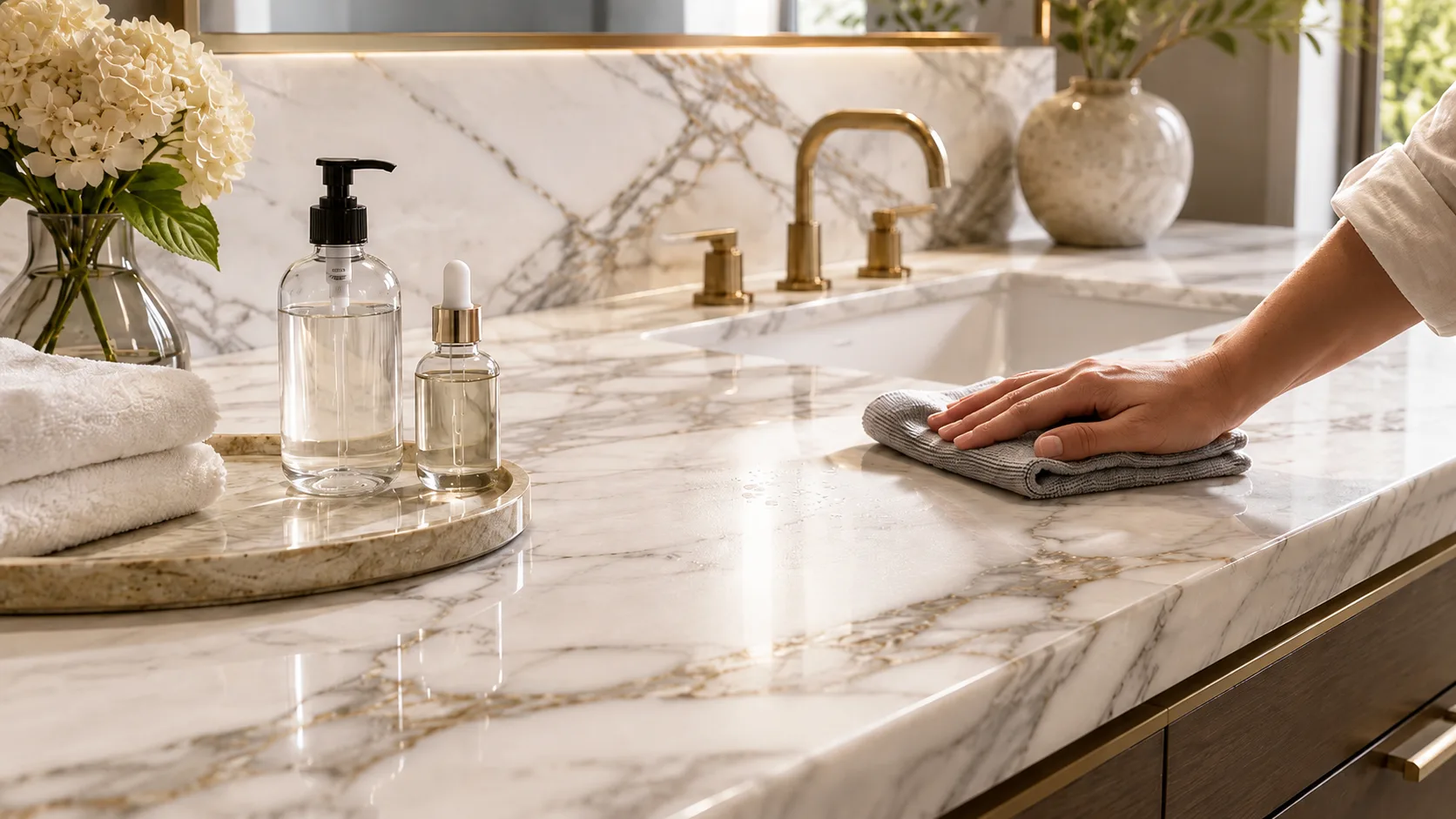
Harsh acidic cleaners and abrasive chemicals can affect certain marble finishes. Cleaning and maintenance products should therefore be selected for natural stone and the particular finish being used.
The specific stone, sealing treatment, installation and maintenance routine all influence how a marble sink performs over time.
With appropriate care, natural stone can age beautifully and remain part of an interior for many years.
How Do You Clean a Marble Sink?
For regular cleaning, a soft cloth together with a pH-neutral cleaner suitable for natural stone is generally a sensible approach.
Soap, cosmetics and other residues should not be allowed to remain on the surface unnecessarily.
Any protective treatments or sealers should also be selected according to the type of stone and its finish.
Because natural stones differ, maintenance recommendations should always take the specific material into consideration rather than assuming that every marble behaves identically.
Why Should You See the Actual Stone?
Natural marble is not a perfectly uniform material selected from a digital color code.
Even blocks extracted from the same marble variety can show noticeable differences in veining, color and movement.
Whenever possible, seeing the actual stone or finished piece can therefore be valuable, especially when choosing premium marble with expressive veining.
The position of those veins across the sink can have a major impact on the final appearance.
This is also one of the most exciting aspects of commissioning a natural stone piece.
The material itself becomes part of the design process.
Is a Marble Sink a Trend or a Timeless Design Choice?
Interior trends change constantly.
Natural stone does not depend on a single design era.
Marble has been used in architecture for centuries, even though the forms in which we use it continue to evolve.
Modern marble sinks demonstrate this perfectly.
A minimal contemporary basin can combine a highly modern shape with a material whose history reaches far beyond current trends.
This combination allows well-designed marble pieces to feel both contemporary and timeless.
From Natural Stone to a Finished Marble Vertex Piece
At Marble Vertex, the character of the natural stone is treated as part of the design rather than simply as a raw material.
The veining, proportions, form and intended use of the piece are considered together to create a sink that feels individual to its setting.
Different natural stones offer different possibilities.
Carrara White can create restraint and clarity. Calacatta varieties can introduce movement and drama. Rosso Levanto can become a rich focal point. Nero Marquina can create depth and contrast, while travertine offers a warmer architectural expression.
The important question when choosing a marble sink is therefore not simply:
“What color should it be?”
Look at the stone.
Look at the craftsmanship.
Look at the proportions, surfaces and details.
Because what makes a marble sink exceptional is not marble alone.
It is the craftsmanship that understands the marble.
Frequently Asked Questions
Are marble sinks practical for everyday use?
Yes. When properly fabricated, installed and maintained, marble sinks can provide both functional use and distinctive natural-stone aesthetics. Their maintenance requirements differ from those of ceramic fixtures.
Can marble sinks stain?
Marble is a natural stone and can have varying degrees of porosity. The stone variety, surface finish, protective treatment and day-to-day use can all influence stain resistance. Appropriate maintenance is important.
Can a marble sink be made to custom dimensions?
Yes. Natural stone sinks can be produced in different widths, depths, basin shapes and configurations to meet specific project requirements.
What is the best marble for a bathroom sink?
There is no single marble that is best for every bathroom. Color, veining, finish, design, maintenance expectations and the architecture of the room should all influence the choice.
Do marble sinks work in modern bathrooms?
Absolutely. Minimal forms, fluted surfaces, wall-mounted designs and integrated marble sinks can work particularly well in contemporary bathrooms.
Why choose a handmade marble sink?
Natural stone is inherently unique. Skilled craftsmanship can respond to the individual veining and characteristics of the stone, helping each piece develop its own identity.
Bring the Character of Natural Stone Into Your Space
Marble is more than a decorative surface.
It is a natural material formed over immense periods of time and transformed through design and craftsmanship into something we can interact with every day.
When the right stone, thoughtful design and skilled workmanship come together, a marble sink becomes more than a bathroom fixture.
It becomes part of the architecture.
Explore the Marble Vertex marble sink collection, discover different natural stones or contact us to discuss a custom marble sink designed for your project.